
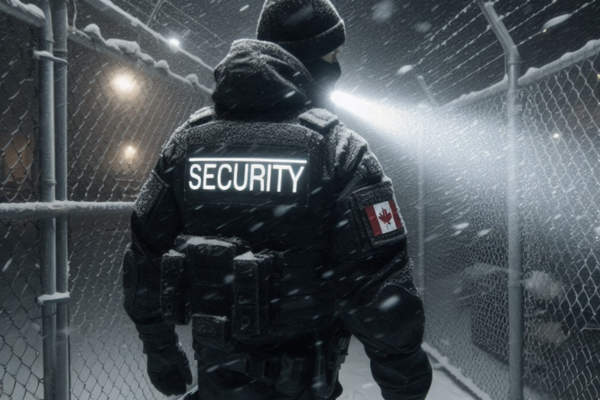
It’s 3:00 AM in February. The wind chill is hitting -30°C, and you are forty minutes into a perimeter patrol at an industrial yard. Your fingers are numb, your toes are stinging, and your focus is shifting from monitoring the site to simply enduring the cold.
For security professionals in Canada, winter isn't just a season; it’s an occupational hazard. The cold degrades your dexterity, slows your reaction time, and distracts you from potential threats. At Guardian Outfitters, we believe that being "Mission-Ready" means being weather-ready.
This guide breaks down the science of staying warm without sacrificing the mobility and access you need to do your job safely.
The "Stop-Start" Danger Cycle
Unlike hikers or skiers who keep moving constantly, security guards face a unique physiological challenge: the "Stop-Start" cycle.
-
Active Phase: During high-intensity moments - like rushing to an alarm or climbing a stairwell - your heart rate spikes, causing your body to generate heat and sweat.
-
Static Phase: Low-intensity moments - like returning to a drafty gatehouse or standing watch outside.
If you are dressed incorrectly, the sweat from the active phase gets trapped against your skin. As soon as you stop moving, that moisture cools rapidly. Since water conducts heat away from the body 25 times faster than air, you can go from comfortable to hypothermic in minutes.
The solution isn't just "more clothes." It’s the Tactical Layering System.
Layer 1: The Base (Cotton Kills)
The biggest mistake rookies make is wearing a cotton t-shirt under their uniform. Cotton is hydrophilic—it loves water. It absorbs sweat and holds it against your skin like a cold compress.
The Professional Solution: You need a hydrophobic synthetic layer that "wicks" moisture away to the outside, keeping your skin dry. We recommend the Rothco ECWCS Thermal Top. It uses expedition-weight polyester fleece that traps body heat while mechanically moving sweat away from your torso. This is critical when wearing a ballistic vest, which acts as a vapour barrier and increases sweating around your core.
Layer 2: The Insulation (Trapping Dead Air)
Your second layer is responsible for trapping warmth. However, for tactical purposes, it cannot be too bulky; you need to maintain a full range of motion for defensive tactics or physical restraint.
While fleece is common, it often degrades quickly under the friction of a duty belt or vest. We recommend the Flat Knit Sweater, made from 100% Control-Pil Acrylic, this sweater is the industry standard for a reason. It provides the high-loft heat retention of wool but is engineered to resist "pilling" (the fuzz balls that form on lower-quality fabrics). This ensures you maintain a sharp, authoritative uniform appearance while trapping that critical layer of warm air against your body.
Layer 3: The Shell (Duty-Ready Protection)
Civilian winter parkas are dangerous for security work. They are often too long, blocking access to your duty belt, and they lack the durability to withstand abrasion from brick walls or fences.
The Professional Solution: The Guardian Duty Gear V2 Patrol Jacket is engineered specifically for this environment. It features a 3-in-1 design with a removable fleece liner, allowing you to adapt instantly if you move from outdoors to indoors.
Most importantly, it features Side Zippers for Duty Belt Access. In an emergency, you cannot waste seconds fighting with the hem of your coat to reach your baton, radio, or handcuffs. The V2 jacket allows your gear to remain covered and dry but instantly accessible. It also includes a 12-pocket design, which is vital for keeping battery-operated devices (like phones and radios) close to your body heat to prevent battery drain.
Extremities: Hand Protection Strategy
Cold hands are a liability. If you lose manual dexterity, you cannot effectively key your radio, write a report, or use your defensive tools. However, one glove does not fit every mission. We recommend choosing your gear based on your specific post:
For Active Patrols & Dexterity: First Tactical Hard Knuckle
If your shift involves constant movement, driving, or frequent use of your phone, the First Tactical Hard Knuckle Gloves are the industry favourite for a reason. They offer superior protection and dexterity without the bulk, making them ideal for high-activity shifts where you are generating your own body heat.
For Static Posts & Deep Cold: Guardian Kevlar Search Gloves
If you are standing guard at a perimeter or working a door in -20°C, you need mass to stop the wind. The Guardian Duty Gear Search Gloves are the thickest, warmest option in our lineup. The full leather outer shell cuts the wind better than synthetic mesh, while the double-layer Kevlar liner acts as insulation. They may be a traditional style, but when the temperature drops, they are the most reliable barrier against the freeze.
Footwear Traction
Slips and falls on icy pavement are the number one cause of injury during winter shifts.
-
The Gear: Ensure your boots, such as the Original SWAT series, have a slip-resistant outsole. If you need a boot that does it all in the snow, the Metro Air 9" is our top recommendation for deep winter. It features 200g Thinsulate™ insulation, keeping your toes warm even when standing still on concrete. Combined with the HydroGuard waterproof bootie and a specialized cold-weather outsole for ice traction, this is the boot for the guard who battles the elements all night.
-
The Socks: Your boots are only as good as your socks. Wear Merino Wool socks. Unlike cotton, wool keeps you warm even if it gets wet from stepping in a slush puddle. We don't carry any at this time but I'm sure we will in the future!
Winter Safety Protocol Checklist
Before you start your shift, run through this mental checklist:
-
Base Layer Check: Are you wearing synthetics? No cotton.
-
Battery Check: Are your phone and radio stored in internal jacket pockets?.
-
Traction Check: Are your boot soles clean of packed snow?
-
Visibility Check: In a snowstorm, visibility drops. Ensure your jacket has reflective "SECURITY" panels so you are visible to vehicles in parking lots.
Stay Mission-Ready
Winter in Canada is unforgiving, but with the right system, it’s just another day on the job. Don't wait until the first blizzard to check your kit.